






Tell us the story behind Partners in THINC.
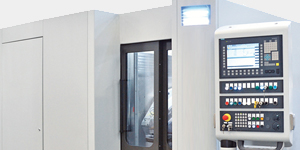
Okuma introduced THINC—The Intelligent Numerical Control—in 2004, which is a PC-based operating platform using the Okuma Sampling Path (OSP) control as a foundation. THINC’s open architecture allows integration with nearly any application or peripheral, so it was meant to be highly adaptable and customer driven from the very beginning.
We established Partners in THINC three years later, in 2007, as a means of bringing together experts from around the world representing manufacturers of the equipment that will be linked by THINC, with the goal of harnessing their knowledge to provide customer solutions. As an example, one of our first projects involved designing a cell for a wheel manufacturer, so we brought together the developers of robotics, tooling, workholding, material handling, and others to design the most-efficient production system we could. Then we shared the results of our work with the client, saying “we guarantee that this cell will provide you with X amount of uptime, but if you break up the package you void the guarantee.”
We’ve assembled the partners in our program very carefully, after all, so we can only guarantee our production figures if component parts of the cell design remain intact, as this wheel manufacturer chose to do.
How did potential customers react to this model?
We share our proposals with top leadership, and what they found attractive was the guaranteed uptime. But people want to have choices, too, so we decided to have no more than two or three companies representing each market sector as part of the group. But they are what we consider to be the top manufacturers in the world—companies like Fanuc Robotics, Blum, Schunk, Marposs, Kennametal, and Sandvik Coromant, just to name a few of our 41 members—so that inspires a great deal of confidence in itself. So if we’re asked to design a manufacturing cell for a company we can recommend a selection of proven solutions and systems. But we always make clear that if someone insists on a make or manufacturer that isn’t part of our group, we can no longer guarantee the end results.
Tell us more about how this process works.
While we have worked on greenfield projects, where a company is building a new facility and wants us to help design their production line from square one, most often we’re approached by companies with specific challenges to overcome. A client might visit us here at our 58,000 square-foot facility and say “in order to remain competitive we need to increase throughput by 30 percent, reduce cost by 15 percent, and still maintain a high level of quality and accuracy.”
We will begin by learning about what they’re making, the materials, what machines and tooling they’re using, how the current production line is configured, the degree of automation, and what specific challenges—or “pain points”—they’re struggling with. One thing we encounter a lot these days is volume reduction, where a manufacturer is now making 10 parts instead of 10,000 during a run. In that situation we’d want to make sure their setups and changeovers were as fast and efficient as possible, that they were using the right materials, and that their equipment was versatile enough to allow for a wide range of uses.
Another company might be interested in adding a “lights out” night shift, where the machines can run unattended. In that case we would design an intelligent system that would provide live information and even send notifications to smartphones or home computers should someone’s attention be required, and we would make sure those notifications would go to the right person like the production manager or maintenance supervisor. So we don’t provide canned solutions, each one is tailored to meet the customer’s needs.
With such a high degree of collaboration, this seems like an academic approach to manufacturing.
It really is, and we do work with the Rochester Institute of Technology and Clemson University’s International Center for Automotive Research, or CU-ICAR, where they’re using Okuma machines on projects for their master’s- and doctorate-level programs. So it’s exciting to be in a position to bring all these highly skilled and intelligent people together to the benefit of our customers. Everyone is part of the puzzle that results in our customers achieving their goals and objectives.
MORE INFORMATION: Call (704) 587-6789 or go online to www.partnersinthinc.com or www.okuma.com.


