





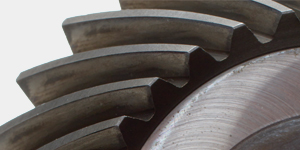


If a mechanical or electromechanical component has to function for extended periods in an extreme environment, a perfluoropolyether (PFPE) lubricant just may be the key to long life and smooth performance.
PFPEs are a family of fluorinated synthetic fluids that are used to formulate the most thermo-oxidatively stable lubricants available today. They are slippery, long-chain fluoropolymers that wet surfaces well, making them good materials for lubricants. The layer of fluorine atoms that surround each PFPE molecule makes electron exchange difficult, which keeps oxidation in check. Oxidative stability not only extends lubricant life, it reduces carbonaceous deposits that can exacerbate wear and shorten component life. Available in a variety of viscosities—from very light for low-temperature, low-torque applications to very viscous for use as sealants or in more heavily loaded applications—PFPEs can be used “neat” as lubricating oils, or combined with thickeners, typically polytetrafluoroethylene (PTFE), to make a variety of PFPE greases.
PFPEs are well suited for demanding environments. They can withstand temperatures from -90°C to +250°C, and even higher spikes. Extremely inert, they don’t crack, craze, discolor, or dissolve plastics. Nor do they swell, shrink, or embrittle natural rubber or other elastomers. Non-flammable, they also resist harsh chemicals, fuel oil, and brake fluids. And because of their low volatility they are often the lubricants of choice for high-vacuum environments.
While the various PFPEs share these general tribological characteristics, all PFPEs are not created equal. And there’s the rub for the design engineer. To select the best PFPE for a specific application and operating environment, it’s necessary to understand some of the distinctions among the different PFPE fluids. Sometimes the differences are subtle and may seem insignificant, if not esoteric. But in extreme environments, where a lubricant is pushed to the limits, these seemingly small variances in base oil chemistry are often what separate failure from success.
Linears, Pendents, and Temperature
There are four different types of PFPE fluids: PFPE-K, PFPE-Y, PFPE-M, and PFPE-Z—or, in PFPE shorthand, K, Y, M, and Z fluids. Though all PFPEs are composed of carbon, oxygen, and fluorine atoms, each type of fluid is the product of different starting materials and manufacturing processes. Consequently, the molecular structure—that is, how the carbon, oxygen, and fluorine atoms are linked together—is different. These structural differences affect the fluid’s low-temperature capability, ability to prevent wear, viscosity index, and volatility—all critical factors in lubricant selection.
Structurally, each PFPE molecule is classified as either a linear or pendent. M and Z fluids are linear PFPEs. Y and K fluids are pendent molecules. A linear PFPE is a straight polymer chain, much like a snake of interlocking K’NEX®, the rod and connector construction toy. They are very flexible molecules, able to remain fluid at much lower temperatures than pendents. Depending on the viscosity, M oils can remain fluid and lubricious to about -75°C. The pour point of a very light viscosity Z fluid goes even lower, to -90°C. Of course, with this added cold-temperature performance comes added cost. Grease formulated with a Z fluid can cost as much as $500/lb., about four times the cost of grease formulated with M fluids. By contrast, the Y and K fluids are more economical but do not function well much below -40°C, a temperature easily reached by synthetic hydrocarbon lubricants.

Film Strength, Viscosity Index, Volatility
While linears get the nod for extreme low-temperature applications, pendents deliver more film strength, which means better wear prevention, especially under heavier loads. Again, molecular structure shapes the fluids’ lubricating characteristics. Pendent molecules are like a two-dimensional K’NEX model. They have side chains, sometimes called branches, which make them more rigid. While these branches decrease the molecule’s flexibility, they form a series of lattices that help prevent mating parts from coming into contact.
One exception is worth noting. Compared to the usually more robust pendents, linear Z fluids seem to deliver superior performance as lubricants for sintered, a.k.a. powdered-metal, bearings. It is believed that the very low surface tension of the M fluid, combined with the sheer volume of oil in a properly impregnated sintered bearing, enables this particular linear PFPE to wet very effectively the nooks, crannies, and surface of sintered parts to retard friction and wear.
Whether using grease or oil, the viscosity of the base oil is another important selection criteria. Low-torque, low-temperature applications require a relatively light oil, while high-speed, high-temperature, heavily loaded devices call for a more viscous base oil. In addition, the viscosity of the oil should remain relatively constant throughout the temperature range of the application; otherwise the oil may gum up at low temperatures or waft away at high temperatures. In either case, lubricant is depleted. Viscosity Index (VI) is a dimensionless number that describes how much viscosity varies with temperature: the higher the number, the less change. As with temperature and film strength, the molecular structure of a PFPE affects its VI (see Table 1).
Because of their flexibility, linear PFPEs usually perform better in applications where the operating environment has wide-temperature excursions. When tested at -40°C, +40°C, and +100°C, M and Z fluids yield a very respectable VI of 340. In contrast, pendent Y and K oils had VIs ranging from 60 to about 135, which approximates the VI of a synthetic hydrocarbon.
All PFPEs are known for low volatility, but even the tendency to vaporize is influenced by molecular structure or, more specifically, the molecular weight. Generally, at equal viscosities, the higher the molecular weight, the lower the volatility. Note, however, that the molecular weight of any fluid is actually an average of the molecular weights of each molecule that makes up the fluid. So, volatility is also dependent on the homogeneity of the molecules in a given batch of fluid. If the molecules in a batch of K fluid, for example, have a narrow range of molecular weights, the oil is less volatile than a batch of K fluid with a wide range of molecular weights. Lighter molecules, sometimes called fractions, tend to vaporize easily—which hastens lubricant depletion and component failure.
The range of molecular weights in a batch of oil can be controlled during production or in post-production through fractional distillation, a process that removes the lighter, more volatile fractions. For critical applications, like connectors in an anti-lock braking system, testing the volatility of each batch of PFPE oil is required.
What happens when an application calls for the characteristics of more than one PFPE fluid? Blend them. Recently we blended a linear and a pendent PFPE to formulate a new grease for an automotive bearing. The application called for the load-carrying ability of a pendant at -40°C. While there are pendants that function at -40°C, their viscosity is too low, which jeopardizes wear reduction. A standard pendant would offer good wear protection, but it would cause torque problems at -40°C. The solution turned out to be a 50/50 blend of a K and an M fluid. The K fluid was viscous enough to ensure good load-carrying ability; the Z-fluid ensured performance at -40°C.


