





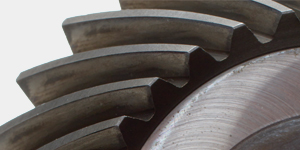


Is there anything that can still be considered new in bevel gear tooth theory? Most experts in the transmission layout industry would probably find the question interesting, but not crucial. The thing that really matters in the calculation and design of axle transmissions is the quest for more clever bridging of the gap between the requirements for noise, payload, manufacturing costs, and process safety.
At first glance, the requirements for spur gear units are the same. The methods used to deal with noise problems in spur gears are tried, tested, and understandable: In addition to optimization contact ratio—in other words, the number of tooth pairs which are simultaneously engaged—the crownings and entanglements are designed for the expected load in such a way that the rotation transmission is as free of defects as possible, and the toothing contact is always smooth and low-noise.

If one wishes to answer the question of why this happens successfully in spur gears but not that simply in bevel gears, one must clarify the relevant differences. In the case of spur gears, the tooth profile is always an evolvent, which is provided with minor modifications. In mathematics, an evolvent is described as a self-equidistant curve, which basically means that the tooth contact does not change with a change in the axle spacing. Bevel gears cannot provide this advantage. On the one hand, the tooth height profile is an octoid instead of an evolvent. On the other hand, bevel gears have to manage with three-dimensional and distinctly larger axle displacements.
In Figure 1, the pinion drives the convex ring gear flank with its concave flank. The pinion tooth force works against the ring gear tooth force. Two components of this reaction force cause a reduction in the offset ΔV and an increase in the axial pinion position ΔH, and the third force component causes a change to the axle angle and an axial displacement of the ring gear. Depending on the stiffness of the axle housing, the pinion will be displaced approximately towards the top right for this load case.
These displacements in ΔV and ΔH result in a different position of the contact pattern. Depending on the diameter of the tool used, the effect of the contact pattern migration is either more or less pronounced. Normally the contact pattern migrates during forward travel of the vehicle (here the expert talks about drive mode) with increasing negative change of ΔV and positive change of ΔH outwards at the axle drive gear tooth head. This effect is shown as a diagram in Figure 2.

For the design of the tooth geometry, this is at first a drastic reduction, since only a certain part of the tooth flank is available for rotation transmission, depending on the load case. In the case of very low torques, minor small housing deformations have to be considered, and consequently the contact pattern will also be adjusted corresponding to the design in the scheduled position. Since low torques do not cause elastic flattening and deflection of the tooth, the running characteristics of the transmission correspond to those of the calculated load free tooth contact analysis in the scheduled mounting position. The situation changes when higher torques are to be transmitted. Firstly, the transmission will be deformed due to the tooth forces and cause a distinct contact pattern position and, moreover, the contact area will increase. This is the result of tooth deformation; the tooth flank flattens and the teeth will be additionally elastically displaced.
Locally Distinct Crowning
These simple considerations lead to the fact that different areas can be defined on the tooth flanks, which are in contact at different loads. Due to the fact that the contact pattern moves to the outer diameter and to the tooth tip of the ring gear teeth with increasing load, it is practical to place the contact pattern at the front half of the tooth in the load-free mounting position. The expected deformation under load can therefore be taken into account. If, however, there are manufacturing and transmission mounting tolerances to be considered, some additional expostulations result that also lead to a correction of the contact pattern position. These act on the light load area, which is usually the frontal portion of the tooth.

The methods known from spur gears can now be applied to the adapted crowning, taking into account the different load zones. It is clear that no appreciable crowning is required for the area of low load tooth contact. In this area they can be reduced so that the accuracy of the rotation transmission becomes the highest possible. In contrast, we need high crownings in the high load area. High crowning should prevent the contact going beyond the tooth border, which would cause an erratic increasing load distribution at the rear tooth end.
Ideally, a bevel gear set which has the highest payload and causes the lowest noise excitation must have distinct crowning along the tooth flank.
Gearing Systems
The gear engineer has the task of implementing the optimized distinct crowning across the face width in a productive process. To clarify this process, we will initially restrain ourselves to bevel gears with ratios as they are predominantly used for axle transmissions in vehicle construction. Those normally have a transmission ratio of 1:2.5 and higher. This means that ring gears can always be produced in an efficient formate process.
In the formate process, the tooth gap is generated almost as an image of the tool. Besides the grooving infeed—and at the continuous process of the coupling between cutter head and workpiece—there are no other machine movements. The crowning along the face width is generated directly by the shape of the tool.
The generating process offers many more possibilities in this case. Small additional movements are overlaid on the equally generating movement using the method known as modified motion, or UMC®. It is therefore possible to generate distinct crowning diagonally over the tooth flank from toe/tip to heel/root. This changeable longitudinal crowning, however, is only possible in connection with either more or less pronounced side effects. Besides the twisting of the tooth flank, the profile crowning changes partially and very intensively along the face width.

Gearing Theory to Modified Crowning
In spite of the multiple modifications, which can be applied to the generating process, it was not possible in the past to configure the longitudinal crowning along the face width without side effects. This facility is possible for the first time in connection with the use of available cutting or grinding tools through the modified crowning method.
If one wishes to change the tooth flank of a formate ring gear, this can only be done via the so-called plunge position.
The plunge position is the relative position between the tool and the ring gear. It is defined totally by the greatest radial distance S, cradle angle q, machine root angle G, deep position X, and offset a, in addition to the distance of the zero point of the ring gear from the machine center mccp. Of course S and q on the one hand, and a and H on the other hand, can be converted within each other, and mccp can be offset against X and H. All of these values are constant for the plunge process; only deep position X is used as the infeed axle.

If, for instance, the radial distance S is changed, the main result is that the spiral angle of both tooth flanks will change in the opposite direction. If the base angle G is changed and the deep position X is adjusted so that the same tooth height is generated, then primarily the spiral angles of both tooth flanks will change in the opposite direction. The principle of modified crowning uses various plunge positions, which are driven sequentially with uniform machine movement.
As shown in Figure 5, a transformation of the known plunge position adjustment values is carried out. With these transformed values, it is possible to interconnect the distinct plunge positions in such a way that the movement equations of the individual axles correspond to those of a generating movement, in spite of it not being a generating motion. The leading magnitude is the transformed generating angle q, which must run exactly from q1 to q2. Magnitudes S, a, X, mccp, and Γ are described by functions which are dependent on leading magnitude q, which has to change exactly from q1 to q2. This means that the same formal approaches are used for modified crowning as are used for modified motion, but in the case of modified crowning several plunge positions are connected with one another by a harmonic machine movement instead of using a generating movement.

If one compares machine movements for a plunge ring gear with that of a modified crowning ring gear, only the experienced observer would be able to notice the minor difference. After completing the plunge process, the machine axles change their position at an exiguous value, which has basically no influence on the efficiency. This is especially advantageous for continuous gearing, since the additional movement has to be performed only once for all teeth.
An Example
The example in Figure 6 shows the application of modified crowning to a face milling gear as per the face milling principle. The accuracy of the rotation transmission, and therefore the expected noise conduct at the low load area, is about 20 μrad. This is a very good value and a precondition for low running noise.
The change of the longitudinal crowning represented in green only acts on the outer tooth end. It has no influence on the area of the contact pattern, as it is in the low load condition. It is therefore immediately apparent that the very low transmission error cannot be changed due to the increase of the longitudinal crowning represented in the figure.

With the use of modified crowning for lapped face hobbing gears, or for ground face milling gears, a design tool has been developed which produces an uncompromising bridge between payload and low noise for the first time. The use of totally normal tools such as cutter heads or grinding wheels is especially important. The minimum additional movements require only fractions of seconds so that the efficiency of this method is ensured.


